So reads a text message from one of the girls I met at Parangtritis. She is worried that I’ll be scared off by knowing she’s a Muslim.
---
The lack of Americans here in Yogyakarta is a little disappointing. Not that I came to hang out with my fellow countrymen, but seeing Europe so well represented among the foreigners here brings out my national pride a bit. I’ve got nothing against Europeans per se, but sometimes they’re a bit too, well, European for me. What does that mean, you ask? It means walking around tropical Yogyakarta in galoshes with your pant legs tucked into them. Yes. It means sporting baby mullets like they never went out of style. It means trekking around the crowded city streets dressed as if you’re on safari. It means dropping imperial references in your long-distance phone conversations (“Look, it’s not a bloody empire – it’s a shop.”). It means asking me where else I’ve been in “Yava”. The travelers I’ve met have all been really nice, but I’d be overjoyed to see few more American faces, for comfort if nothing else.
So where are all my compatriots? Most probably think 1) Indonesia = Bali, or 2) Indonesia = terrorist den. As for the first assumption, I don’t really blame them. The selection of guide books on Indonesia is mediocre at best. Lonely Planet has the most current one, and most of the others seem to skim over or completely omit the world’s fourth most populous nation from their pages. Take Lonely Planet's “Southeast Asia on a Shoestring”, for example. Surely this book should have some useful information about Indonesia, seeing as how it geographically dominates Southeast Asia and is perfect for those on a tight budget. I look in the table of contents: Malaysia, Thailand, Cambodia, Laos, Vietnam, the Philippines, Bali. Wait. Are you serious? Bali? That’s the best they could do - the most expensive and tourist-ridden Island of the whole archipelago? I wanted to slap the nearest Barnes & Noble employee and demand satisfaction.
As for the second assumption, again I don’t really blame people because of the scant sensationalist media coverage available to them. The grotesque caricatures of Indonesia crafted by conflict-hungry journalists who perpetually long to be on the “front lines” (and make-believe they are anyway if their locale doesn’t suffice) could hardly be further from the reality of daily life here. And if the stilted journalistic reports coming from Indonesia don’t convince tourists to stay away, the US government’s travel warning finishes the job.
As to the question of what it is like living in a “Muslim country”, I don’t really even know how to begin to answer that. First ask yourself what it’s like living in a “Christian country”, because neither the United States nor Indonesia is a theocracy. Things are completely different here, from the food to the climate to the way you shake hands. Islam is tightly woven into the social fabric of life here, and for normal people it’s not the sort of obsession it can be for some in the US with conflicted self-identities who feel alienated by the dominant culture.
Five times a day, Mosque speakers blare Azhan - the Islamic call to prayer. Some Mosques have good singers, and others… not so good. I sometimes try to imagine what peoples’ reaction would be if they heard Azhan in the States. For many, the melodic Arabic voice would evoke fear, shock and indignation. Neighborhood councils would brood. Members of Congress would be called. All hell would break loose, and the Muslim community would have its usual disunified and schizophrenic reaction. Here, Azhan is at most a friendly reminder to pray, and at minimum innocuous background noise. Think church bells.
Jilbab is the term for the Indonesian-style Islamic head covering. Many girls wear them, many girls don’t. Jilbabs are an integral part of the visual landscape. They don’t send off the “I’m too Muslim to talk to you” vibe that one might feel in the States, where donning a head scarf has more confrontational connotations among the general public and is often interpreted as a political statement. Jilbabs are many things to many women – for some they are more fashion accessories than anything else. For others they reflect a deeply personal commitment to a spiritual ideal. For many they are worn just out of habit, and some women wear them only when conducting official business, attending formal events, or praying. For most they are probably a shifting combination of several of these things. I have only once seen anybody wearing a veil, and that was at McDonalds (which in Indonesia is, of course, 100% halal). Interestingly, many girls here will wear both jilbab and the most hip-hugging of jeans at the same time. This can create moments of intense confusion when scanning from the ground up.
As-salaam-alaikum is the standard greeting here. For example, if you were to venture into a shop and wanted to get the attention of the clerk napping in the back (something you need to do here pretty often), you could call out “As-salaam-alaikuuuumm”, intoning your voice on the last two syllables. It is also common practice to use this greeting when answering the phone or welcoming somebody in general. It doesn’t have the same pious, solidarity-affirming enthusiasm that’s present when it’s used in the US – here it’s just like saying “hello”. Ya Allah (emphasis on last syllable of Allah) means “oh my God”. I think it rolls off the tongue better than its English counterpart. Other common Muslim expressions like insha’Allah and masha’Allah are also used, but it seems Ya Allah is used more universally than the other two.
As in other Muslim-majority countries, passing and receiving things with your left hand is a no-no. This is due to the Islamic injunction to use that hand for what is dirty (i.e. wiping your arse).
Many people here are very pious compared to the average American. There is no concealment of religion in public like we have in the States. There’s almost always either Azhan, parts of the Quran, or monotonous sermons in Indonesian being delivered from the loudspeakers of Mosques. Jilbabs can be seen everywhere. At bookstores, the “Islamic” sections are among the biggest, and many TV soap operas feature feuding teenagers dressed in Muslim garb. Islam is quite at home in Java, and it exists now much the way it did when it first came here – peacefully. I get no sense of the coercion, sexism, or intolerance so many people fear. But intolerance is not the Javanese way - Javanese would rather turn a blind eye to something than rant and rave and decapitate people. [There is one notable exception to this rule - the rare but deadly bout of amok-amok, during which utter chaos ensues and anyone's head is fair game, especially Chinese Indonesians. Recent cases include 1965 and 1998.]
Now combine all this with a thriving commercial culture that lines every street with food stalls, an obsession with American fashion that clothes teenagers in tight jeans, imitation chucks, and intricately patterned shirts, a robust consumerism that makes people buy cell phones that cost more than their motorbikes, and an intense desire for upward mobility that drives many a kampung girl to date decrepit old bule-bule, and viola! you have the wonder that is Indonesian popular culture.
There are pockets of extremism in Java and other islands of Indonesia, for sure. The real danger in all this is not so much the strength of these extremist ideologies and organizations but more the weakness and ineptitude of the Indonesian government – which has proven in many instances unwilling to uphold its own laws and dispose of vigilante groups like the FPI, who frequently vandalize bars and other Western-oriented businesses. (In general, the government is hardly visible here. Police are hardly seen outside their stations, and when they’re out they’re usually just directing traffic.) The “Islamic” nature of such extremist groups earns them a blind eye from many local politicians who can’t stand the thought of being seen as “anti-Islamic”. Indonesia cannot let these sores fester for very much longer without suffering the consequences – be they the loss of lives, the loss of foreign investment, or the loss of tourism revenue. Judging from the lack of Americans here in Yogya, I’m guessing the latter is already happening.
Saturday, July 19, 2008

Wednesday, July 16, 2008
On Sickness
At first being ill makes you exhausted. Later it makes you worried. And at a certain point, it makes you downright furious. I’ve just about reached that point here in Yogyakarta. I wasn’t naïve enough to expect not to get sick on this trip, but this is more than I signed up for (well, actually not really). This past week has been spent falling in and out of illness, with my stomach being the focal point of all the trouble. I can’t tell which has more nasty bugs here – the food or the internet café computers. Everything is starting to piss me off – my medicine not working, my body not recovering fast enough, not ever being able to really trust the food here, the MOSQUITOES (may Allah curse their tiny souls), the heat, the smog… Even things unrelated to my sickness start to get under my skin at times. I’ve begun a downward spiral of cynicism that is probably only exacerbating whatever illness I have at the moment. I think it might be necessary, though, to temper all the enthusiasm I had coming into this trip. But what irks me more than anything else is that my sickness has started to interfere with my research here.
On Saturday I had planned to travel to Parangkusumo with Nur to start doing interviews, but I was so sick on Friday night that I had to cancel everything for the next day. I think I fell ill from eating some sketchy food at a rumah makan padang – something that sounds great in theory but is actually pretty horrible in practice. What a rumah makan padang is is a restaurant where there are plates of all kinds of pre-cooked dishes stacked up in the window, and you pick and choose which ones you want. Sounds delicious, right? Perhaps, until you start to think about it and then realize that all those dishes of food have just been chilling there for God-knows-how-long, bathing in their own juices. And I'm not convinced that the restaurant owners are rushing to change them over every few hours (or even days - it's a 24 hr restaurant)... Needless to say, my stomach was not pleased with my decision to eat there, and proceeded to perform for me its best rendition of Krakatau. It was the worst 6 hours of my life. Doubled over on the toilet, puking up water, I wondered how much more abuse my body could take before it gave out. One or two days was my guess. I tried to take small sips from my bottled water, but every drop made me more nauseous. Dizzy and weak, I made my way to the next room and laid down on a bed of cold porcelain tiles, wearing just my t-shirt and a towel. It was three in the morning. When I finally felt stable enough to turn on my side and try to rest, I was greeted by a friendly horde of mosquitoes. I weakly fended them off while drifting into dreamland.
Prayers, Peddlers and Prostitutes
A few days back a friend of mine told me about something going on at Parangkusumo beach (the western side of Parangtritis beach). He said that when the weekday Kliwon of the Javanese calendar falls on a Tuesday (Selasa in Indonesian), certain rituals are held there. The same is true for when Kliwon falls on a Friday (Jumaat). From what I've gathered, these are believed to be days of heightened spiritual activity when prayer or meditation can be most fruitful. I need to find out more about their significance, though. My friend suggested we go there on that night, but he didn't have rituals in mind.
Along the outside of the enclosure, a couple dozen onlookers peered over the chest-high wall. I joined them there to watch.
While watching the rituals I felt that there was a subtle energy or charge running through the place. Maybe it was just a combination of me being hyped and the lingering vibration from the 15 minute bike ride I had just taken.
I wanted to take some photographs of the rituals, but I wasn't sure if that was against protocol. I waited to see if anyone else was shooting, but everyone was just watching. I asked Nur if there was someone we could ask about this, and he told me he would talk to one of the men sitting next to the entrance of the rock enclosure. He walked over and I continued watching.
When I walked over to where he was, I saw him crouched down, smiling widely as he delicately offered the man his lighter and a cigarette. That's Java-style diplomacy at work for you. Nur ended up chatting with the man for more than ten minutes, and was given some very interesting information about the rituals. "So, is it alright to take photos?" I asked him after he returned. "Ahhh - I forgot to ask!" he laughed.
Here is what Nur learned from speaking to the man: He (the man) has been coming to Parangkusumo for rituals since he was a teenager. He prays not for material things but for inner peace/spiritual tranquility. He says it truly works for him because all of his (4) sons & daughters are where they should be in school, he's had no trouble paying for their education, and the ones that have graduated have all found jobs right away. He said that if he is at peace spiritually, success and material well-being will be attracted to him. He told Nur that people come from all over Java on the Selasa Kliwon and malam Jumaat Kliwon nights, and on the annual soroh night, people come from all over Indonesia. People of faiths other than Islam can come and pray, he said,and Javanese are not the only ethnic group that visit.
Taking pictures turned out to be fine, as long as no flash was used. I took pictures and continued to watch the rituals.
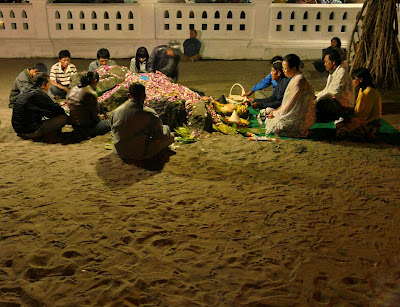

This man assists people with their prayers. Here he is chanting an Islamic formula.

Spreading flowers.

That basket was being taken away after being offered at the rock.

This is where the sand of the beach meets the edge of Parangkusumo. This area stretches down toward the central square. Vendors galore.
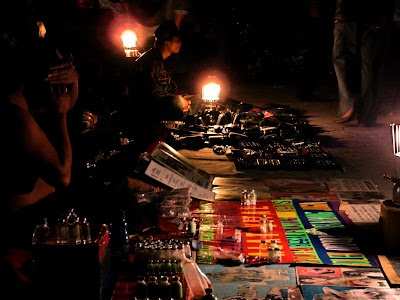
Selling aphrodisiacs. Look closely at the bottom right of this picture, you can see some of the sexy photos. This wasn't the person selling crocodile penis oil.

Many of the sales pitches were quite theatrical.
"There are so many bits there on this night," he told me. "It is like a market. You have to burrrjin."
"What?"
"Burrrjin." The word rolled off his tongue a second time.
"Virgin?" I asked.
"No no no. Burrrjin. For the price."
"Oh, you mean bargain," I replied.
"Yes. If they are still young, like 20 years old, maybe 50 or 60 thousand [~ $6-7 US]. If they are old, maybe 30,000," he explained.
I was indeed keen to sharpen up my bargaining skills, but I didn't really want to practice with prostitutes. Maybe t-shirts or purses might be a better place to start. I asked my friend a few questions about the prostitution there, eager to learn more - this is exactly the kind of thing that my research is concerned with. I was told that the prostitutes come from all over Java to work on these nights, and that their presence is tolerated by those in charge of the rituals because they bring in extra local income through room rentals. I will definitely ask about this in my interviews.
The next day I made arrangements for my research assistant to accompany me to the events at Parangkusumo. I haven't mentioned this yet, but I've found a research assistant for my project. His name is Nur and he's a little older than me. He recently finished his master's degree in linguistics and he speaks great English compared to all the other Indonesians I've met here so far. I think that's due to him being a literature buff. Ibu Kelik's son introduced me to him, and after discussing the ins and outs of my project, we talked some about Pramoedya Ananta Toer and modern Indonesian history. At one point he said: "history is a narrative of power". I knew right then that I'd found the right guy for the job. Equally importantly, Nur is a good communicator and appears knowledgeable about the myriad subtleties involved with talking to Indonesian people. He has some experience translating articles, grant proposals, and a book, though he has not done interpreting work before. So far he's been great and has given me some valuable suggestions for my project. I'm paying him 20,000 Indonesian rupiah per hour. That's a little less than $2.20 US. It sounds like a pittance but it's on the higher end of the payscale for professional guides here. So he's being well compensated. I wanted to set his wage a tad lower than that, but since he's doing such a great job it doesn't bother me.
When the day came and I went to see if my friend was ready to leave for the beach, I walked in to see his friend scratching red welts into his back with a coin. The red lines ran horizontally outward from his spine, making him look like some sort of tiger-man. He told me wasn't feeling so good because he had masuk angin [lit "enter wind"]. Basically in the medical imagination here there is an idea that wind can enter your body and make you sick. Kind of like our idea of catching a cold, sort of maybe not really... Long welts were being scratched into his back, chest, and arms to let the wind escape from inside his body. He told me he wasn't going to accompany Nur and I this time. I left alone and met Nur up the street.
When the day came and I went to see if my friend was ready to leave for the beach, I walked in to see his friend scratching red welts into his back with a coin. The red lines ran horizontally outward from his spine, making him look like some sort of tiger-man. He told me wasn't feeling so good because he had masuk angin [lit "enter wind"]. Basically in the medical imagination here there is an idea that wind can enter your body and make you sick. Kind of like our idea of catching a cold, sort of maybe not really... Long welts were being scratched into his back, chest, and arms to let the wind escape from inside his body. He told me he wasn't going to accompany Nur and I this time. I left alone and met Nur up the street.
As we sped south toward Parangkusumo on his motorbike, I spoke with Nur about my goals for the excursion and what I was interested in seeing there. To my disbelief, he raised his left hand and began gesturing profusely while speaking. We must have been going at least 50 mph. As we hurdled each bump in the road I felt the front wheel try to pull away from the grip of his right hand. They say that making your body go completely limp at the point of impact increases your chance of surviving a high-speed fall.. I mentally prepared to relax my muscles while praying that centripetal force would keep the bike straight. Every red light was a sigh of relief until we finally arrived.
From the brief descriptions I read online about these nights, I was expecting maybe a few dozen older people solemnly performing some quiet ritual on the beach, but instead the place was packed and quite busy. But this is typical of my experience here - my entire trip has been one long deconstruction of the myriad mental images I created about Indonesia before coming. So surprises are the norm.
The rituals were being performed inside part of a large courtyard-type area. This rectangular area, flanked by waist-high stone walls, contains a mosque, a central walled area containing two sacred rocks, two smaller semi-walled structures (perhaps only for ceremonial use), and two larger open-air structures. I'll try to make some sketch up of the place soon. Besides the structures, which are all near each other, there is a span of grass that reaches the paved area at the beach's edge (where I encountered the sheep before). There were also small swathes of grass alongside the paved paths that circle the rock enclosure.
The rituals were being performed inside part of a large courtyard-type area. This rectangular area, flanked by waist-high stone walls, contains a mosque, a central walled area containing two sacred rocks, two smaller semi-walled structures (perhaps only for ceremonial use), and two larger open-air structures. I'll try to make some sketch up of the place soon. Besides the structures, which are all near each other, there is a span of grass that reaches the paved area at the beach's edge (where I encountered the sheep before). There were also small swathes of grass alongside the paved paths that circle the rock enclosure.
Despite the hundreds of people milling about, there was a calm, quiet ambiance about the place, like you could tell something important was going on. I made my way to the enclosure with the sacred rocks. There was a somewhat steady stream of people entering and leaving it. Near its entrance, inside, was a large thatched mat. At the front of it sat two older men, each wearing traditional Javanese dress. Before them were two bucket-sized stone containers in which smoldering fire/incense burned. They also held bundles of lit incense sticks. Further in front of them lay the two rocks, protruding from the sand and bathed in flowers.
When people entered the enclosure, they first sat behind the two men tending the fires, apparently saying some kind of prayer. Some of them brought with them offerings of flowers wrapped in banana leaves, with which one of the fire-tenders would, after performing their prayers, make 3 clockwise motions over the flames. Then the banana leaf packet would be returned to its owner and shortly thereafter the group would stand and make their way to the rocks. There they would pray, sprinkle their flowers over the rock, and then either pray more, meditate, or sift their hand through the pile of flowers on top of the rock. This was all done very quietly and intently.
When people entered the enclosure, they first sat behind the two men tending the fires, apparently saying some kind of prayer. Some of them brought with them offerings of flowers wrapped in banana leaves, with which one of the fire-tenders would, after performing their prayers, make 3 clockwise motions over the flames. Then the banana leaf packet would be returned to its owner and shortly thereafter the group would stand and make their way to the rocks. There they would pray, sprinkle their flowers over the rock, and then either pray more, meditate, or sift their hand through the pile of flowers on top of the rock. This was all done very quietly and intently.
Along the outside of the enclosure, a couple dozen onlookers peered over the chest-high wall. I joined them there to watch.
While watching the rituals I felt that there was a subtle energy or charge running through the place. Maybe it was just a combination of me being hyped and the lingering vibration from the 15 minute bike ride I had just taken.
People were all over the place outside the rock enclosure. A few were engaged in some kind of standing or sitting meditation. Just outside the entrance to the rock enclosure, a group of five or six people stood silently in a semi-circle, swaying gently while they concentrated on their prayer. As I walked past them I hoped I wasn't crossing any delicate metaphysical boundaries or channels. In the nearby wall-less structures there were people sprawled out, resting, smoking, and chatting softly. Nearby in the grass, older men and women sold massages. Here and there along the edges of the paved footpaths stood prostitutes - most older than 25, I'd guess. The whole place was a strange mix of leisure, commercial activity, and ritual.
I wanted to take some photographs of the rituals, but I wasn't sure if that was against protocol. I waited to see if anyone else was shooting, but everyone was just watching. I asked Nur if there was someone we could ask about this, and he told me he would talk to one of the men sitting next to the entrance of the rock enclosure. He walked over and I continued watching.
When I walked over to where he was, I saw him crouched down, smiling widely as he delicately offered the man his lighter and a cigarette. That's Java-style diplomacy at work for you. Nur ended up chatting with the man for more than ten minutes, and was given some very interesting information about the rituals. "So, is it alright to take photos?" I asked him after he returned. "Ahhh - I forgot to ask!" he laughed.
Here is what Nur learned from speaking to the man: He (the man) has been coming to Parangkusumo for rituals since he was a teenager. He prays not for material things but for inner peace/spiritual tranquility. He says it truly works for him because all of his (4) sons & daughters are where they should be in school, he's had no trouble paying for their education, and the ones that have graduated have all found jobs right away. He said that if he is at peace spiritually, success and material well-being will be attracted to him. He told Nur that people come from all over Java on the Selasa Kliwon and malam Jumaat Kliwon nights, and on the annual soroh night, people come from all over Indonesia. People of faiths other than Islam can come and pray, he said,and Javanese are not the only ethnic group that visit.
Taking pictures turned out to be fine, as long as no flash was used. I took pictures and continued to watch the rituals.
I looked on while a man knelt with his forehead touching the rock while an older man next to him held a palm an inch or two above his back. Some sort of healing maybe?
While we were watching, Nur and I discussed the relationship between Islam and Javanese animism. He explained to me that many Javanese adulterated their local religion with Islamic elements. I stopped in my tracks at that statement - it was so telling of the differences in our perspectives. Naturally I would have thought of Islam as the thing being "adulterated" (I might have used a word with fewer normative connotations, though). Didn't even realize I was working under that assumption until Nur said what he said.
Later we walked toward the beach, past the long rows of vendors. There was a wide variety of aphrodisiacs being sold - perhaps for the prostitutes' customers. One guy was selling crocodile penis oil. Next to his vials he had some sexy pictures set out. They looked to be from the early 90s or 80s. One was picture of bikini-clad white woman with the word ingin [to desire] covering her crotch. Other people sold hats, clothes, rings with magic stones, Islamic prayer beads, trinkets, the list goes on. We saw one guy from Papua New Guinea in full Papuan attire. He was selling souvenirs and what looked like some kind of herbal medicines. The place was bustling and loud - several people had megaphones which they used to advertise their products.
Fires and lanterns dotted the beach, and at first I thought they might be for rituals. Silly me. Most of them were for people either selling massages or cooking food (to sell). There was an amazing view of the stars and the Milky Way, which had a magical effect when combined with the rumbling black ocean at our feet. I can imagine how a place like that has so much folklore associated with it. It really felt mystical and full of energy.
After soaking in the scenery at the beach we went back into the square/courtyard area. We saw more people doing their rituals, and also saw many prostitutes standing around. They all looked like they were waiting on a bus to come, or something. It felt strange seeing them in such close proximity to the mosque and the sacred rock enclosure. The whole evening was pretty strange in general.
[Wow I thought I might never finish this post! Note: This night was around July 1st or 2nd.]

[Wow I thought I might never finish this post! Note: This night was around July 1st or 2nd.]

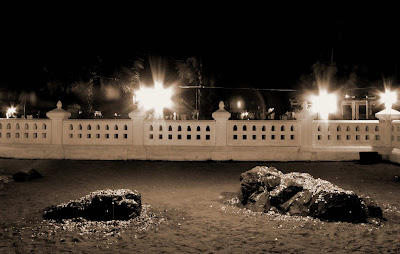
The two sacred rocks. Ground zero.

Sifting through flower petals after praying. A fellow bystander later told Nur that each offering [of flowers] consists of 4 types of flowers. One of these, called kantil, is searched for among the petals after one offers their prayers and flower offering. She told Nur that the kantil represents one's prayer.

Various people/groups of people pray at the rocks simultaneously. Here a ritual food offering is being made. The white conic structures are rice.

This man assists people with their prayers. Here he is chanting an Islamic formula.

Spreading flowers.

That basket was being taken away after being offered at the rock.

This is where the sand of the beach meets the edge of Parangkusumo. This area stretches down toward the central square. Vendors galore.

Selling aphrodisiacs. Look closely at the bottom right of this picture, you can see some of the sexy photos. This wasn't the person selling crocodile penis oil.

Many of the sales pitches were quite theatrical.
Sunday, July 6, 2008
Meeting Pak Agus
[No one's real name is used here]
*** Note: There is a post preceding this one that is still being worked on. References to "Kliwon Selasa", "Kliwon Jumaat", and my research assistant will not make sense until you read it. For background - Kliwon Selasa/Kliwon Jumaat are two days when many people go to Parangkusumo [Parangtritis's western side] to do rituals at two sacred rocks there. My research assistant has been hired and his name is Nur. Will finish that post soon. ***
This evening I went with my friend Dewi to meet her lecturer (& friend) Pak Agus. He lives deep in Bantul in one of the areas completely destroyed by the 2006 earthquake. He actually lost his mother and his sister during the quake. All the houses there were new, Dewi told me. She said that the government gave each family 10 million rupiah after the earthquake. That's about a thousand dollars. I didn't know you could build a house with that much money. I guess with gotong-royong anything is possible. [Gotong-royong is sort of like obligatory community service within one's neighborhood. It's a deeply rooted tradition in Javanese society. Think of it as something similar to a barn-raising, except ongoing.]

Pak Agus teaches at a local university - I forget which one it is. He's a thin, balding man with a high pitched voice and a sort of bouncy energy about him. His wife was really nice and his daughter was adorable. She pranced around like she owned the place, wearing a dress covered with Peter Pan characters. We sat on the floor and watched a bit of sinetron [Indonesian tv drama] before Pak Agus got home. Then Dewi and I sat at the table with him and he spoke with her about her research. A few minutes later a plate of steaming hot fried bananas was set in front of me. They were grown by his neighbor, Pak Agus told me. They tasted even better than they smelled - kind of like fried plantains except better and not soggy. I think I'm getting spoiled eating all this fresh food here... The other day at Dewi's house, we ordered lunch from the fish place next door - "the fish place next door" being a dude with a fishing rod sitting at the river that runs next to Dewi's street. Dewi told him what size fish she wanted and about 20 minutes later she went back and returned with a huge baked and seasoned fish. But I digress...
After Dewi and Pak Agus spoke about schoolwork for 20 minutes or so, I asked him a few questions about Parangtritis/Parangkusumo. He told me that he's very interested in that area, but he can't go there because his neighbors will think he's going to buy prostitutes. Haha! Maybe if he was to go with the rest of his family it wouldn't be a problem, he said. But he told me that even if he were to go in the daytime, people would still have their suspicions. Parangtritis/Parangkusumo seems to have an unsavory reputation among people in the Bantul/Yogya area due to all the prostitution that goes on there. He told me that there are prostitutes there not only on the Kliwon Selasa & Kliwon Jumaat nights, and also offered to introduce to a few neighbors of his that often go there in search of sex. Here is the rest of what he told me:
The Kliwon Selasa/Kliwon Jumaat rituals have been going on for generations; they are nothing new.
If people want to secure a new job, get some money, etc, they might go and do a ritual at the rocks at Parangkusumo.
When Pak Agus was younger, during his high school years (he was born in 1960), there were many foreign tourists that visited Parangtritis each year. They've all been scared off by terrorism, he says. This must be, because I saw not more than three foreigners at the beach all day when I was there last week.
There did not used to be many prostitutes at Parangtritis/Parangkusumo when he was young. He says that after a big prostitution complex at Kotagede [an area near Yogyakarta] was shut down by the police, they relocated en masse to Parangtritis. He forgets which year this happened in. I'm going to try to find some archived info about that, either from the Bantul regency government or some sort of newspaper archival source. Hugely relevant to my research. As a result of the influx of sex workers, all the sexual supplement vendors popped up there; in the past there have been vendors there on Kliwon Selasa / Kliwon Jumaat nights but they didn't sell that kind of stuff, he told me.
The girls come from elsewhere in Java, especially Surabaya. He told me that a lot of girls left Yogyakarta to work in Surabaya, and many left there to work in Yogya. Kind of like an exchange program for sex workers, he joked.
Having sex can actually be a part of the doing your ritual there. From what I understood of Pak Agus's explanation, after offering your prayers or meditating at the rocks, you may be divinely inspired to make love with somebody. Doing this would sort of complete your ritual and help to ensure that your prayer will come true. This holds for both men and women, prostitute or not. I need to find out more about this. My research assistant Nur told me something similar - that a girl (we were discussing the prostitutes at the time), if she seeks some sort of material wish or reward, may have sex with a man to help bring about its manifestation. In any case, Pak Agus told me that in the past there were only a handful of prostitutes at Parangtritis/Parangkusumo, and they were mostly involved with people partaking in the rituals. Also, they worked rather covertly. Now they walk around freely in the open, not appearing the least bit wary of being seen, and they are there purely for economic reasons. I asked him if he thought that people might feel the rituals have been polluted by their presence; he said he didn't believe they had any impact. Conversations like this will really help to inform my interview script, which has been drafted but is still in progress.
Also, Pak Agus has offered to help me with my project. He told me he has several friends at Parangtritis and that he'd be happy to take me down there to talk to people. His English isn't advanced enough to interpret during interviews, but if I could go there with him and my research assistant, that would be great. I think he might be an excellent starting point for my snowball sampling and a good general resource. I'm so grateful that the people I've met here in Yogya have been so warm and helpful to me. It's all personal connections... If I was staying in some hotel or hostel I wouldn't have had the chance to meet any of these people and I might be stuck in a traveler's cafe like Via Via every night. That is a scary thought.
*** Note: There is a post preceding this one that is still being worked on. References to "Kliwon Selasa", "Kliwon Jumaat", and my research assistant will not make sense until you read it. For background - Kliwon Selasa/Kliwon Jumaat are two days when many people go to Parangkusumo [Parangtritis's western side] to do rituals at two sacred rocks there. My research assistant has been hired and his name is Nur. Will finish that post soon. ***
This evening I went with my friend Dewi to meet her lecturer (& friend) Pak Agus. He lives deep in Bantul in one of the areas completely destroyed by the 2006 earthquake. He actually lost his mother and his sister during the quake. All the houses there were new, Dewi told me. She said that the government gave each family 10 million rupiah after the earthquake. That's about a thousand dollars. I didn't know you could build a house with that much money. I guess with gotong-royong anything is possible. [Gotong-royong is sort of like obligatory community service within one's neighborhood. It's a deeply rooted tradition in Javanese society. Think of it as something similar to a barn-raising, except ongoing.]

Pak Agus teaches at a local university - I forget which one it is. He's a thin, balding man with a high pitched voice and a sort of bouncy energy about him. His wife was really nice and his daughter was adorable. She pranced around like she owned the place, wearing a dress covered with Peter Pan characters. We sat on the floor and watched a bit of sinetron [Indonesian tv drama] before Pak Agus got home. Then Dewi and I sat at the table with him and he spoke with her about her research. A few minutes later a plate of steaming hot fried bananas was set in front of me. They were grown by his neighbor, Pak Agus told me. They tasted even better than they smelled - kind of like fried plantains except better and not soggy. I think I'm getting spoiled eating all this fresh food here... The other day at Dewi's house, we ordered lunch from the fish place next door - "the fish place next door" being a dude with a fishing rod sitting at the river that runs next to Dewi's street. Dewi told him what size fish she wanted and about 20 minutes later she went back and returned with a huge baked and seasoned fish. But I digress...
After Dewi and Pak Agus spoke about schoolwork for 20 minutes or so, I asked him a few questions about Parangtritis/Parangkusumo. He told me that he's very interested in that area, but he can't go there because his neighbors will think he's going to buy prostitutes. Haha! Maybe if he was to go with the rest of his family it wouldn't be a problem, he said. But he told me that even if he were to go in the daytime, people would still have their suspicions. Parangtritis/Parangkusumo seems to have an unsavory reputation among people in the Bantul/Yogya area due to all the prostitution that goes on there. He told me that there are prostitutes there not only on the Kliwon Selasa & Kliwon Jumaat nights, and also offered to introduce to a few neighbors of his that often go there in search of sex. Here is the rest of what he told me:
The Kliwon Selasa/Kliwon Jumaat rituals have been going on for generations; they are nothing new.
If people want to secure a new job, get some money, etc, they might go and do a ritual at the rocks at Parangkusumo.
When Pak Agus was younger, during his high school years (he was born in 1960), there were many foreign tourists that visited Parangtritis each year. They've all been scared off by terrorism, he says. This must be, because I saw not more than three foreigners at the beach all day when I was there last week.
There did not used to be many prostitutes at Parangtritis/Parangkusumo when he was young. He says that after a big prostitution complex at Kotagede [an area near Yogyakarta] was shut down by the police, they relocated en masse to Parangtritis. He forgets which year this happened in. I'm going to try to find some archived info about that, either from the Bantul regency government or some sort of newspaper archival source. Hugely relevant to my research. As a result of the influx of sex workers, all the sexual supplement vendors popped up there; in the past there have been vendors there on Kliwon Selasa / Kliwon Jumaat nights but they didn't sell that kind of stuff, he told me.
The girls come from elsewhere in Java, especially Surabaya. He told me that a lot of girls left Yogyakarta to work in Surabaya, and many left there to work in Yogya. Kind of like an exchange program for sex workers, he joked.
Having sex can actually be a part of the doing your ritual there. From what I understood of Pak Agus's explanation, after offering your prayers or meditating at the rocks, you may be divinely inspired to make love with somebody. Doing this would sort of complete your ritual and help to ensure that your prayer will come true. This holds for both men and women, prostitute or not. I need to find out more about this. My research assistant Nur told me something similar - that a girl (we were discussing the prostitutes at the time), if she seeks some sort of material wish or reward, may have sex with a man to help bring about its manifestation. In any case, Pak Agus told me that in the past there were only a handful of prostitutes at Parangtritis/Parangkusumo, and they were mostly involved with people partaking in the rituals. Also, they worked rather covertly. Now they walk around freely in the open, not appearing the least bit wary of being seen, and they are there purely for economic reasons. I asked him if he thought that people might feel the rituals have been polluted by their presence; he said he didn't believe they had any impact. Conversations like this will really help to inform my interview script, which has been drafted but is still in progress.
Also, Pak Agus has offered to help me with my project. He told me he has several friends at Parangtritis and that he'd be happy to take me down there to talk to people. His English isn't advanced enough to interpret during interviews, but if I could go there with him and my research assistant, that would be great. I think he might be an excellent starting point for my snowball sampling and a good general resource. I'm so grateful that the people I've met here in Yogya have been so warm and helpful to me. It's all personal connections... If I was staying in some hotel or hostel I wouldn't have had the chance to meet any of these people and I might be stuck in a traveler's cafe like Via Via every night. That is a scary thought.
Wednesday, June 25, 2008
Beaches and Bitches
On 6/24 I went with Ibu Kelik to Parangtritis beach - ground zero for my research project. After spending countless hours scanning through images of the beach on the internet and reading up on it, actually going there was a little surreal. It was like meeting a celebrity, though that makes me sound like a total weirdo...
We got to the beach after a bumpy 30 minute bus ride. Buses don't really stop in Yogyakarta; they just slow down a bit and open their doors. It's your job to jump on. It's all about timing... I've seen the frailest old ladies jump on, with huge boxes too. Getting off is equally ridiculous but even more dangerous due to the sea of oncoming traffic you're usually thrust into. Every bus comes equipped with a guy who hangs out the side door announcing the bus's arrival to everyone along the street. He also walks around and collects your fare after you get on. Bu Kelik has warned me that there is a fair share of pickpockets roaming the city buses. Haven't had a problem so far.
As you approach the little road that leads to Parangtritis beach, there's losmen after losmen and a hotel here and there. (Losmen are basically small, ultra-budget hotels.) I also saw a sign advertising a new beach resort that's under construction. I'm going to find out more about that sometime soon. More losmen, a few souvenir shops and probably more than 30 food stalls follow you to the beach's edge.
It's difficult to appreciate just how big Parangtritis beach is from photographs - it's expansive, man! The waves there are very loud and powerful, and you can feel them in your chest. Swimming is forbidden due to treacherous undercurrents. I walked all the way down to the cliffs at one end and back around to the other edge, taking pictures along the way. I'm so glad my entire camera lens is protected by the 62mm tele-adapter & lens filters I bought - there was sand and salt and fog all over the place. Keeping my glasses clear was futile after a few minutes.
There was a bunch of little kids everywhere splashing, playing, and flying kites. Kites are really popular with the kids here in Indonesia. Driving into Jakarta from the airport, I saw a bunch of slummy, dilapidated tin-shack blocks lining the highway that had colorful clothes hanging outside. From within the slums I could see kites reaching out to the sky. It was interesting to see them from afar and know that somewhere within that slum, a kid was playing. It was somewhat comforting when being confronted by poverty like that.
Besides little kids, there were several teenage couples hanging around the beach, holding hands or hugging in the surf. I guess it would be a great place to bring your sweetheart. I only saw two or maybe three foreigners during my whole time at the beach.
*** Okay dammit there is a "no smoking" sign right above my head on the wall in this internet cafe, but people here could care less - hence the burning sensation in my eyes.***
After about an hour and a half, Bu Kelik left to go run a few of her million-and-one errands. I stayed and walked westward toward Parangkusumo - a beach often described as "the western part of Parangtritis beach". I knew that somewhere near there there was a really important site central to all the folklore associated with Parangtritis beach. I found out it was within a nearby village and not directly on the beach, so I headed in.
Upon entering the settlement, I walked through a courtyard littered with sheep. One was standing in the middle of the path as I approached. It stopped chewing and looked up at me blankly, baaaaaa-ing. Have you ever been baaaaaa-ed at by a sheep before? It makes you want to laugh for some reason - the sound is so anthropomorphic. At any rate I called the sheep's bluff and kept walking as it made way to the side. I'll admit I sized it up before proceeding, though.
And there it was - encompassed by small white concrete walls - the sacred rock where Nyai Roro Kidul (Java's sea-bound spirit-queen and protector) met with Panembahan Senopati (the divinely guided founder of the last Javanese Muslim royal house (continued today by Yogyakarta's Sultan/governor & national presidential candidate Sri Sultan Hamengku Buwono X). The rock was showered with wilted flower petals and surrounded by spent incense sticks. It being a major locus of Javanese cultural tradition and folklore, I was really amped to stand not ten feet away from it. As I gazed at the rock, deep in thought, and elderly man from the village approached.
"As-salaamu-alaikum, Bapak," I said as he came within earshot. (Bapak is a polite term of address for older males. The literal meaning is "father" but it's used similarly to "Sir".) We started a conversation in Indonesian. It mostly consisted of me asking him a question, him answering and elaborating, me not understanding much beyond his initial answer, me repeating in my own words what I thought he said, and him either nodding yes or elaborating further. His lack of a full set of teeth didn't help things.
We had a great conversation despite my inability to understand most of what was being said. He told me he'd seen tourists from all over the world who had come to see the sacred rock, and that they were knowledgeable about the folklore. When I asked him whether there were many people in the village there who would be interested in talking with me about the folklore there, he said there were. A guy standing nearby agreed. Sweet. I think I'm going to focus on that village for my interviews. That approach will be less problematic than approaching random people on the beach, because they could come from anywhere in Indonesia.
He walked with me up to the beach and after about 20 minutes we went to a foodstall and got lunch before I left. It's amazing how much you can communicate with someone without understanding their words.
---
Later that night I went with some of the kampung guys (one 29, one 27, and another still in high school) to hear a reggae band play at a bar near Sosrowijayan street (a big tourist area). The bar - called "Lucifer" (with a backwards "e") - was dimly lit with pink walls that created a comfortable yet slightly sketchy ambiance. The tables there were made of heavy dark wood that made you feel like a you were a viking or something. The place was mostly empty except for a few people lurking at the bar and back tables.
The band had a vocalist, drummer, bassist, guitarist, and hand percussionist. Almost all their songs were covers of old songs by Bob Marley or UB40, but they did do a few in Indonesian. The lead singer was this little guy with dreads hanging down his back who actually looked a little like Bob Marley. He was pretty weird looking, and sang all the songs with a heavy Indonesian accent.
One of the guys I came with had brought along a water bottle filled with Indonesian wine. It was very sweet and very potent. [After since trying it a second time, I think it might be a little too sweet for my taste.]
Once the band got into their set a little bit, they didn't sound half bad. -But I don't know, maybe it was just the wine...
***Ok wow I think they are playing a Celine Dion compilation cd in this internet cafe. Thank god for youtube.***
So towards the end of the set, some dancing took place, involving myself. It was a fun time. After returning from the bathroom later on, there were two girls sitting our table. One of them was in my seat, smoking a cigarette and text-messaging on her cellphone. She had thin, arching eyebrows and dark brown skin. I introduced myself, made smalltalk, etc. She told me she was from Surabaya (Indonesia's second-largest city). When I asked what she was doing in town, she replied that she was working in a salon, doing masas.
"Masas? Apa itu?" I asked. ["Masas? What's that?"]
"Masas," she repeated, taking hold of my arm. I took a deep swig of my Bintang beer and glanced up at the band. She went back to text-messaging for a minute or two, completely ignoring me and making things a little awkward. I just watched the band play. While the singer mangled the lyrics to "I Shot the Sheriff", she leaned in suddenly, resting her hand on my thigh.
"Mau masas, atau nggak?" she whispered through a cupped palm. ["Want a massage, or not?"]
I didn't respond.
"Di hotel," she breathed into my ear, tightening her grip on my leg.
"Nggak," I replied, spotting a gecko run across the wall.
"Kenapa?" she asked. ["Why?"] I told her I was ok and took another drink of my Bintang.
The Indonesian term for "prostitute" is kupu-kupu malam: "butterfly of the night".
"She is, how you say - bits," my friend said as we strapped on our helmets for the ride home.
"Apa?" I asked.
"Bits," he repeated.
"Oh you mean bitch, ya?"
We got to the beach after a bumpy 30 minute bus ride. Buses don't really stop in Yogyakarta; they just slow down a bit and open their doors. It's your job to jump on. It's all about timing... I've seen the frailest old ladies jump on, with huge boxes too. Getting off is equally ridiculous but even more dangerous due to the sea of oncoming traffic you're usually thrust into. Every bus comes equipped with a guy who hangs out the side door announcing the bus's arrival to everyone along the street. He also walks around and collects your fare after you get on. Bu Kelik has warned me that there is a fair share of pickpockets roaming the city buses. Haven't had a problem so far.
As you approach the little road that leads to Parangtritis beach, there's losmen after losmen and a hotel here and there. (Losmen are basically small, ultra-budget hotels.) I also saw a sign advertising a new beach resort that's under construction. I'm going to find out more about that sometime soon. More losmen, a few souvenir shops and probably more than 30 food stalls follow you to the beach's edge.
It's difficult to appreciate just how big Parangtritis beach is from photographs - it's expansive, man! The waves there are very loud and powerful, and you can feel them in your chest. Swimming is forbidden due to treacherous undercurrents. I walked all the way down to the cliffs at one end and back around to the other edge, taking pictures along the way. I'm so glad my entire camera lens is protected by the 62mm tele-adapter & lens filters I bought - there was sand and salt and fog all over the place. Keeping my glasses clear was futile after a few minutes.
There was a bunch of little kids everywhere splashing, playing, and flying kites. Kites are really popular with the kids here in Indonesia. Driving into Jakarta from the airport, I saw a bunch of slummy, dilapidated tin-shack blocks lining the highway that had colorful clothes hanging outside. From within the slums I could see kites reaching out to the sky. It was interesting to see them from afar and know that somewhere within that slum, a kid was playing. It was somewhat comforting when being confronted by poverty like that.
Besides little kids, there were several teenage couples hanging around the beach, holding hands or hugging in the surf. I guess it would be a great place to bring your sweetheart. I only saw two or maybe three foreigners during my whole time at the beach.
*** Okay dammit there is a "no smoking" sign right above my head on the wall in this internet cafe, but people here could care less - hence the burning sensation in my eyes.***
After about an hour and a half, Bu Kelik left to go run a few of her million-and-one errands. I stayed and walked westward toward Parangkusumo - a beach often described as "the western part of Parangtritis beach". I knew that somewhere near there there was a really important site central to all the folklore associated with Parangtritis beach. I found out it was within a nearby village and not directly on the beach, so I headed in.
Upon entering the settlement, I walked through a courtyard littered with sheep. One was standing in the middle of the path as I approached. It stopped chewing and looked up at me blankly, baaaaaa-ing. Have you ever been baaaaaa-ed at by a sheep before? It makes you want to laugh for some reason - the sound is so anthropomorphic. At any rate I called the sheep's bluff and kept walking as it made way to the side. I'll admit I sized it up before proceeding, though.
And there it was - encompassed by small white concrete walls - the sacred rock where Nyai Roro Kidul (Java's sea-bound spirit-queen and protector) met with Panembahan Senopati (the divinely guided founder of the last Javanese Muslim royal house (continued today by Yogyakarta's Sultan/governor & national presidential candidate Sri Sultan Hamengku Buwono X). The rock was showered with wilted flower petals and surrounded by spent incense sticks. It being a major locus of Javanese cultural tradition and folklore, I was really amped to stand not ten feet away from it. As I gazed at the rock, deep in thought, and elderly man from the village approached.
"As-salaamu-alaikum, Bapak," I said as he came within earshot. (Bapak is a polite term of address for older males. The literal meaning is "father" but it's used similarly to "Sir".) We started a conversation in Indonesian. It mostly consisted of me asking him a question, him answering and elaborating, me not understanding much beyond his initial answer, me repeating in my own words what I thought he said, and him either nodding yes or elaborating further. His lack of a full set of teeth didn't help things.
We had a great conversation despite my inability to understand most of what was being said. He told me he'd seen tourists from all over the world who had come to see the sacred rock, and that they were knowledgeable about the folklore. When I asked him whether there were many people in the village there who would be interested in talking with me about the folklore there, he said there were. A guy standing nearby agreed. Sweet. I think I'm going to focus on that village for my interviews. That approach will be less problematic than approaching random people on the beach, because they could come from anywhere in Indonesia.
He walked with me up to the beach and after about 20 minutes we went to a foodstall and got lunch before I left. It's amazing how much you can communicate with someone without understanding their words.
---
Later that night I went with some of the kampung guys (one 29, one 27, and another still in high school) to hear a reggae band play at a bar near Sosrowijayan street (a big tourist area). The bar - called "Lucifer" (with a backwards "e") - was dimly lit with pink walls that created a comfortable yet slightly sketchy ambiance. The tables there were made of heavy dark wood that made you feel like a you were a viking or something. The place was mostly empty except for a few people lurking at the bar and back tables.
The band had a vocalist, drummer, bassist, guitarist, and hand percussionist. Almost all their songs were covers of old songs by Bob Marley or UB40, but they did do a few in Indonesian. The lead singer was this little guy with dreads hanging down his back who actually looked a little like Bob Marley. He was pretty weird looking, and sang all the songs with a heavy Indonesian accent.
One of the guys I came with had brought along a water bottle filled with Indonesian wine. It was very sweet and very potent. [After since trying it a second time, I think it might be a little too sweet for my taste.]
Once the band got into their set a little bit, they didn't sound half bad. -But I don't know, maybe it was just the wine...
***Ok wow I think they are playing a Celine Dion compilation cd in this internet cafe. Thank god for youtube.***
So towards the end of the set, some dancing took place, involving myself. It was a fun time. After returning from the bathroom later on, there were two girls sitting our table. One of them was in my seat, smoking a cigarette and text-messaging on her cellphone. She had thin, arching eyebrows and dark brown skin. I introduced myself, made smalltalk, etc. She told me she was from Surabaya (Indonesia's second-largest city). When I asked what she was doing in town, she replied that she was working in a salon, doing masas.
"Masas? Apa itu?" I asked. ["Masas? What's that?"]
"Masas," she repeated, taking hold of my arm. I took a deep swig of my Bintang beer and glanced up at the band. She went back to text-messaging for a minute or two, completely ignoring me and making things a little awkward. I just watched the band play. While the singer mangled the lyrics to "I Shot the Sheriff", she leaned in suddenly, resting her hand on my thigh.
"Mau masas, atau nggak?" she whispered through a cupped palm. ["Want a massage, or not?"]
I didn't respond.
"Di hotel," she breathed into my ear, tightening her grip on my leg.
"Nggak," I replied, spotting a gecko run across the wall.
"Kenapa?" she asked. ["Why?"] I told her I was ok and took another drink of my Bintang.
The Indonesian term for "prostitute" is kupu-kupu malam: "butterfly of the night".
"She is, how you say - bits," my friend said as we strapped on our helmets for the ride home.
"Apa?" I asked.
"Bits," he repeated.
"Oh you mean bitch, ya?"
He nodded. "For maybe 50,000 [~US $6], you can buy," he explained as we turned the corner and sped off into the cold, empty streets. "You like Indonesian girl?"
"Ya," I replied. "Tapi nggak yang bisa dibeli," I laughed into the side of his helmet. ["Yes... but not the ones you can buy."]
"Oh," he laughed.
"Dia nggak bersih," I added. ["She is unclean."]
Monday, June 23, 2008
Making up for lost time
Sorry - I'm trying to keep this current and consistent, so my Jakarta experience will have to be heavily paraphrased:
My friend and his parents were wonderful hosts. His house was beautiful and much better than mine or yours for sure. One time his maid folded my clothes while I was out. I came back and realized what had happened. It was weird - I felt grateful but violated at the same time. If I make a mess, I intend to keep it that way, ya!I went to two nearby malls with my friend and was amazed at their sheer scale and the ridiculously expensive stores they housed (e.g. Gucci, Coach, Hugo Boss, Versace, etc.). A lot of Chinese Indonesians were there. They basically monopolize the private sector in Indonesia and are generally richer than everyone else, so it makes sense.
So after a couple days in Jakarta I went by train to Yogyakarta (pronounced "Johg-jakarta"). I was driven to the airport in my friend's father's black Mercedes Benz truck. Yeah, they're quite rich.
When I reached Jogja a couple of days ago, I experienced a series of shocks:
1) I was met at the Yogyakarta train station by the son of the lady I'm living with. As we walked into the parking lot, I was looking for the car. Too bad we were getting on a motorbike! If you've ever seen third-world motorbiking in action, you'd understand my intense trepidation at that moment. I held on for dear life as we weaved through the streets en route to the house.
2) After criss-crossing streets overloaded with vehicles, we turned into an alleyway and navigated several narrow corridors, passing random people and tightly packed living spaces. Finally we pulled up to the house, which was next to a small messy open courtyard filled with random bits of wood & trash, chickens running about through it all. I reserved comment.
3) I walked inside and met Ibu Kelik ("Mrs. Kelik"). She was nice enough, and there was some beautiful batik artwork hanging in the main room. She instructed me to follow her... ahh my eyes are burning from all the freaking smoke in this country, sorry ya... She instructed me to follow her upstairs. We walked up some concrete stairs which led to a deck with drying clothes strewn about along with miscellaneous stacks of pots and a few potted plants. There was an awning above where the steps were, so they were really open-air, right onto the outdoor "deck". Then up a few stairs to the top floor where my room was. The whole time Ibu Kelik was saying stuff to me in Indonesian & I could only catch about half of it. So she opened the door and showed me a very small, somewhat dingy-looking room with a bed laying on the floor. Hope sweet home. I looked around a bit from the deck, scanning the rooftops around me while a cacophony of distorted Muslim calls to prayer rang out loudly from the nearby mosques. It is something I can only describe as what the end of the world might sound like.
Everything seemed a little (read: extremely) rustic at first, but now I'm pretty much used to it and I can see that I'm actually in a very opportune situation here.
I live in a kampung, which is the basic community unit in Indonesia. It's basically a cluster of homes traversed by smallish streets and alleyways of varying widths. And by homes I mean dwelling places - not like big houses. Most everything is concrete, small, and very close together. It has an insular effect because no one really comes through who doesn't live there or is visiting someone who does. So everyone knows everyone and it's very quiet and homely. Little kids play outside and chickens run around. Most of the buildings are small and very colorful, with shades of pink, yellow, green and blue mostly. There's a few lots with random brush growing and remnants of previous brick houses laying around.
Ibu Kelik is the headmaster of her kampung, so people come to her if they have problems or need a small loan or something. She also handles other notary-type things involving paperwork, but I don't know exactly how all that works. So she knows everyone in the kampung and they all know her. Two days ago, early in the morning (everything starts at around 5am here - so it's barely 8pm now, but it feels like 11pm already) she took me walking around the kampung and introduced me to the people we came across. Everyone is very welcoming and nice. The old ladies we saw at their homes gave me some of the food they were cooking. Walking around was a bit of a sensory overload because the environment was so utterly foreign to me, but it's becoming familiar after a couple of days and I've got my bearings. Today I played some badminton outside the house with some of the kampung kids. It was fun, even though my Indonesian vocabulary set for playing competitive sports is about zilch. Stuff like that makes me feel more connected to the kampung - not just as a visitor but as a participant. If I was in a hotel I wouldn't get to experience anything like this.
One thing I found pretty cool about our kampung is that there is a fund set up for people who need extra money for various reasons. Those with more money will donate to this fund monthly, in amounts between 10 and 50 dollars (she showed me the donor list). It's all set up through someone at the mosque. The recipient list for this month includes about a half-dozen elderly people, a few people with family members in the hospital, a girl adept at reciting Al-Quran who will get to travel to Jakarta because of it, and a couple other folks. The donors get to see the list when donating, so they know exactly who is getting what money. Apparently such a scheme isn't found in other kampungs.
Many elements of kampung life are rather communal, which can be refreshingly different from the general individual focus of life in the US. For example, every morning the day's newspaper is taped up on a large glass screen for everyone to read at their leisure.
- Ya other than that, I've seamlessly adjusted to the Indonesian habit of taking 2 or 3 showers per day - you have to here or else you'll feel like a sticky mess.
- The street food is so cheap man. $0.60 for a meal is on the higher end. I'm eating from street stalls multiple times a day. My stomach was a little upset today, but I think that's from eating too much spicy food the last 24 hrs. [Update: stomach is fine]
- Mosquitoes love my foreign blood. There's this big vent-like thing in my room that they can fly in through. I really need to get a screen for that unless I want to continue to be a mosquito buffet every night.
- I feel very safe in the area I'm staying in, and in Yogyakarta in general. There's a calm vibe about this city - it's more chill and less sketchy than Jakarta.
- Ibu Kelik has been awesome. She seems to have made it her personal mission to facilitate my research project as much as possible. But besides that she's a great host and has a wonderful booming laugh. Her batiks are amazing, too.
- The other day Ibu Kelik's oldest son had a goat slaughtered in the little side courtyard to celebrate the naming of his newborn son. A neighbor came and read a prayer before slicing the goat's throat. Goats have a lot of blood, and it's very thick and very red. Actually two goats were killed that morning. Then they were strung up, skinned, gutted, cleaned, chopped, and cooked into an orange-ish colored stew. The child's name is Diego.
- The hunt is on for a research assistant. I met with one guy from the kampung yesterday and we had a practice interview with his father. He got a degree in English lit at a university here in Jogja. I felt like he was describing things in less detail than was actually given, and a couple times I had to help him find the word he was thinking of. He's a great guy, but I may need someone more fluent in English. After the interview we went out to do a bit of shopping and catch a bite. I learned some very interesting facts from his father which related to my research, though. I may re-interview him in the coming weeks.
- Indonesian pop music makes baby Jesus cry.
- I am now riding on the back of motorbikes with zero fear. The next frontier is driving one. Bu Kelik & co. have suggested it a few times, but I told them that if I drive a motorbike here, I will die. It seems like they're biding their time until a future date when they're going to gang up and force me to do it. I am not looking forward to that day.
Pics coming soon - slow connection, ya.
My friend and his parents were wonderful hosts. His house was beautiful and much better than mine or yours for sure. One time his maid folded my clothes while I was out. I came back and realized what had happened. It was weird - I felt grateful but violated at the same time. If I make a mess, I intend to keep it that way, ya!I went to two nearby malls with my friend and was amazed at their sheer scale and the ridiculously expensive stores they housed (e.g. Gucci, Coach, Hugo Boss, Versace, etc.). A lot of Chinese Indonesians were there. They basically monopolize the private sector in Indonesia and are generally richer than everyone else, so it makes sense.
So after a couple days in Jakarta I went by train to Yogyakarta (pronounced "Johg-jakarta"). I was driven to the airport in my friend's father's black Mercedes Benz truck. Yeah, they're quite rich.
When I reached Jogja a couple of days ago, I experienced a series of shocks:
1) I was met at the Yogyakarta train station by the son of the lady I'm living with. As we walked into the parking lot, I was looking for the car. Too bad we were getting on a motorbike! If you've ever seen third-world motorbiking in action, you'd understand my intense trepidation at that moment. I held on for dear life as we weaved through the streets en route to the house.
2) After criss-crossing streets overloaded with vehicles, we turned into an alleyway and navigated several narrow corridors, passing random people and tightly packed living spaces. Finally we pulled up to the house, which was next to a small messy open courtyard filled with random bits of wood & trash, chickens running about through it all. I reserved comment.
3) I walked inside and met Ibu Kelik ("Mrs. Kelik"). She was nice enough, and there was some beautiful batik artwork hanging in the main room. She instructed me to follow her... ahh my eyes are burning from all the freaking smoke in this country, sorry ya... She instructed me to follow her upstairs. We walked up some concrete stairs which led to a deck with drying clothes strewn about along with miscellaneous stacks of pots and a few potted plants. There was an awning above where the steps were, so they were really open-air, right onto the outdoor "deck". Then up a few stairs to the top floor where my room was. The whole time Ibu Kelik was saying stuff to me in Indonesian & I could only catch about half of it. So she opened the door and showed me a very small, somewhat dingy-looking room with a bed laying on the floor. Hope sweet home. I looked around a bit from the deck, scanning the rooftops around me while a cacophony of distorted Muslim calls to prayer rang out loudly from the nearby mosques. It is something I can only describe as what the end of the world might sound like.
Everything seemed a little (read: extremely) rustic at first, but now I'm pretty much used to it and I can see that I'm actually in a very opportune situation here.
I live in a kampung, which is the basic community unit in Indonesia. It's basically a cluster of homes traversed by smallish streets and alleyways of varying widths. And by homes I mean dwelling places - not like big houses. Most everything is concrete, small, and very close together. It has an insular effect because no one really comes through who doesn't live there or is visiting someone who does. So everyone knows everyone and it's very quiet and homely. Little kids play outside and chickens run around. Most of the buildings are small and very colorful, with shades of pink, yellow, green and blue mostly. There's a few lots with random brush growing and remnants of previous brick houses laying around.
Ibu Kelik is the headmaster of her kampung, so people come to her if they have problems or need a small loan or something. She also handles other notary-type things involving paperwork, but I don't know exactly how all that works. So she knows everyone in the kampung and they all know her. Two days ago, early in the morning (everything starts at around 5am here - so it's barely 8pm now, but it feels like 11pm already) she took me walking around the kampung and introduced me to the people we came across. Everyone is very welcoming and nice. The old ladies we saw at their homes gave me some of the food they were cooking. Walking around was a bit of a sensory overload because the environment was so utterly foreign to me, but it's becoming familiar after a couple of days and I've got my bearings. Today I played some badminton outside the house with some of the kampung kids. It was fun, even though my Indonesian vocabulary set for playing competitive sports is about zilch. Stuff like that makes me feel more connected to the kampung - not just as a visitor but as a participant. If I was in a hotel I wouldn't get to experience anything like this.
One thing I found pretty cool about our kampung is that there is a fund set up for people who need extra money for various reasons. Those with more money will donate to this fund monthly, in amounts between 10 and 50 dollars (she showed me the donor list). It's all set up through someone at the mosque. The recipient list for this month includes about a half-dozen elderly people, a few people with family members in the hospital, a girl adept at reciting Al-Quran who will get to travel to Jakarta because of it, and a couple other folks. The donors get to see the list when donating, so they know exactly who is getting what money. Apparently such a scheme isn't found in other kampungs.
Many elements of kampung life are rather communal, which can be refreshingly different from the general individual focus of life in the US. For example, every morning the day's newspaper is taped up on a large glass screen for everyone to read at their leisure.
- Ya other than that, I've seamlessly adjusted to the Indonesian habit of taking 2 or 3 showers per day - you have to here or else you'll feel like a sticky mess.
- The street food is so cheap man. $0.60 for a meal is on the higher end. I'm eating from street stalls multiple times a day. My stomach was a little upset today, but I think that's from eating too much spicy food the last 24 hrs. [Update: stomach is fine]
- Mosquitoes love my foreign blood. There's this big vent-like thing in my room that they can fly in through. I really need to get a screen for that unless I want to continue to be a mosquito buffet every night.
- I feel very safe in the area I'm staying in, and in Yogyakarta in general. There's a calm vibe about this city - it's more chill and less sketchy than Jakarta.
- Ibu Kelik has been awesome. She seems to have made it her personal mission to facilitate my research project as much as possible. But besides that she's a great host and has a wonderful booming laugh. Her batiks are amazing, too.
- The other day Ibu Kelik's oldest son had a goat slaughtered in the little side courtyard to celebrate the naming of his newborn son. A neighbor came and read a prayer before slicing the goat's throat. Goats have a lot of blood, and it's very thick and very red. Actually two goats were killed that morning. Then they were strung up, skinned, gutted, cleaned, chopped, and cooked into an orange-ish colored stew. The child's name is Diego.
- The hunt is on for a research assistant. I met with one guy from the kampung yesterday and we had a practice interview with his father. He got a degree in English lit at a university here in Jogja. I felt like he was describing things in less detail than was actually given, and a couple times I had to help him find the word he was thinking of. He's a great guy, but I may need someone more fluent in English. After the interview we went out to do a bit of shopping and catch a bite. I learned some very interesting facts from his father which related to my research, though. I may re-interview him in the coming weeks.
- Indonesian pop music makes baby Jesus cry.
- I am now riding on the back of motorbikes with zero fear. The next frontier is driving one. Bu Kelik & co. have suggested it a few times, but I told them that if I drive a motorbike here, I will die. It seems like they're biding their time until a future date when they're going to gang up and force me to do it. I am not looking forward to that day.
Pics coming soon - slow connection, ya.
Sunday, June 22, 2008
30 Hours of Travel
Hey all, I've been in Indonesia a few days now, but I didn't want to skip anything so I'll start off from the beginning.
Ah, the marvels of travel... Who knew getting from point A to point B could be so interesting? My journey halfway across the globe started at the Cincinnati airport (which is actually in N. Kentucky). After a brief lunch with my family, I walked through security and headed for the plane. It still hadn't really sunken in yet, the reality of what I was embarking on. For some perspective: my flight from Cincinnati to LA was the longest distance I had ever traveled. And I was going to Indonesia.
As the plane took off and everything below vanished into points and lines, the harmonizing voices of Crosby, Stills, Nash & Young reverberated through my headphones. That was when everything suddenly became real. "What in the hell am I doing?" I asked myself. Headed to a far corner of the earth with little more than a vague familiarity about my destination and a dissipating reservoir of enthusiasm, apprehension took hold of me.
"Rejoice! Rejoice! We have no choice... but to carry on," the music answered. I closed my eyes, hoping I might wake up back in Cincinnati. Meanwhile the rivers and hills passed by below. When I woke, the landscape was shifting from cropland to desert. Living on the East Coast, it's easy to forget how vast and untouched much of the Western United States is.
I struck up a conversation with the old woman sitting next to me. She was headed to Los Angeles to visit her daughter and newborn grandchild. "I've never met anyone bound for Jakarta," she mused. I told her about my trip and my college studies and she seemed quite impressed. She told me I was "the hope of the future" and that it was "a privilege" to have flown with me. Go figure. We had a great conversation though, discussing everything from natural disasters to the decline of the honeybee to Hollywood ethics. When I declined an airline snack, she called the stewardess back and got two packs of cookies for me. "See, they're good, aren't they?" she asked as I wiped crumbs from the corners of my lips. Later she asked me to send her my address in Indonesia. I think she wants to send me more cookies.
LA
LAX has a very Los Angeles feel to it, which I picked up on even without ever having been there before. It's hard to describe, but definitely tangible. I was able to watch the final game of the Boston/LA NBA finals series there. Interestingly enough, I ended up sitting at a bar with a handful of Filipino Boston fans. It was great. I saw an LA fan who was on the verge of tears.
After the China Airlines ticketing booth finally opened, I stepped into line, destined to stand there for another hour. Without my MP3 player I might have melted into the floor. You never really appreciate just how many Asians there are in the US until you visit LA's international airport. It felt like I could have been in Manila or Ho Chi Minh City. There were people in line with all kinds of enormous boxes full of whatever it was they were importing into their country. I saw one guy with a case of rum. Most of the boxes were marked in Vietnamese or Chinese, so the contents of most of them were a mystery. Bouncy Vietnamese syllables twanged through my ears from both sides. Asia was closing in on me and there was no turning back. A vietnamese woman in front of me stood wearing a white "Baby Phat" jacket. A robed Ch'an (Chinese) monk bent down to tie his laces, exposing a shiny fresh pair of Nike basketball shoes. Trendy Filipino teenagers posed impatiently while the line inched forward.
The security check was uneventful. So yeah on to Taiwan. The flight was probably 15 hours long, and I foolishly agreed to switch my seat so some kid could sit next to his friend. I very much regretted that decision - I ended up crammed in a window seat next to a Chinese man with stinky feet. Regrettably, we were flying so high that I couldn't see anything below the plane. It was bluish, though.

Selling cigarettes on China Airlines. They were duty-free & much cheaper than normal.
Taiwan has an ok airport, not bad but not amazing either. One interesting thing is that they have smoking rooms with sliding glass doors. There was also some pretty neat stuff in the electronics store there - stuff we can't get in the States. Besides that there was nothing new besides a bunch of Asian people.

Taipei, Taiwan

Don't leave your crap in the aisle, please.

I couldn't tell you what is going on in this one...
Ok I'm getting thirsty and as a result my writing is starting to suck so I'll be back later for another update. Coming next time - Jakarta in all its glory!
Subscribe to:
Posts (Atom)